EPA notification obligations for environmental incidents in South Australia
On this page:
- When must businesses notify the EPA in South Australia
- Reporting serious or material environmental harm to the EPA
- Director and officer liability under the EP Act
- EPA enforcement action in South Australia
- Practical steps for responding to an EPA investigation
- How businesses can reduce environmental compliance risk
- Frequently asked questions - EPA notification obligations in South Australia
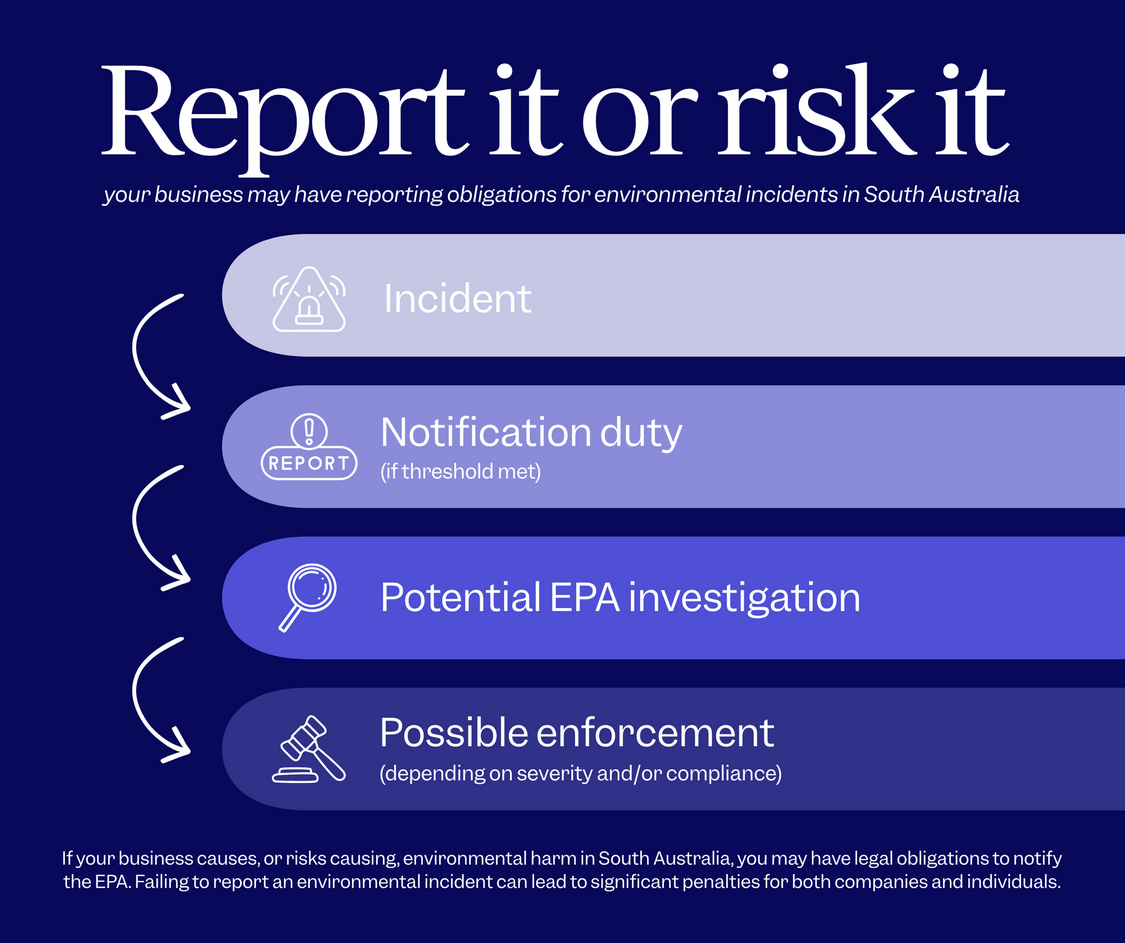
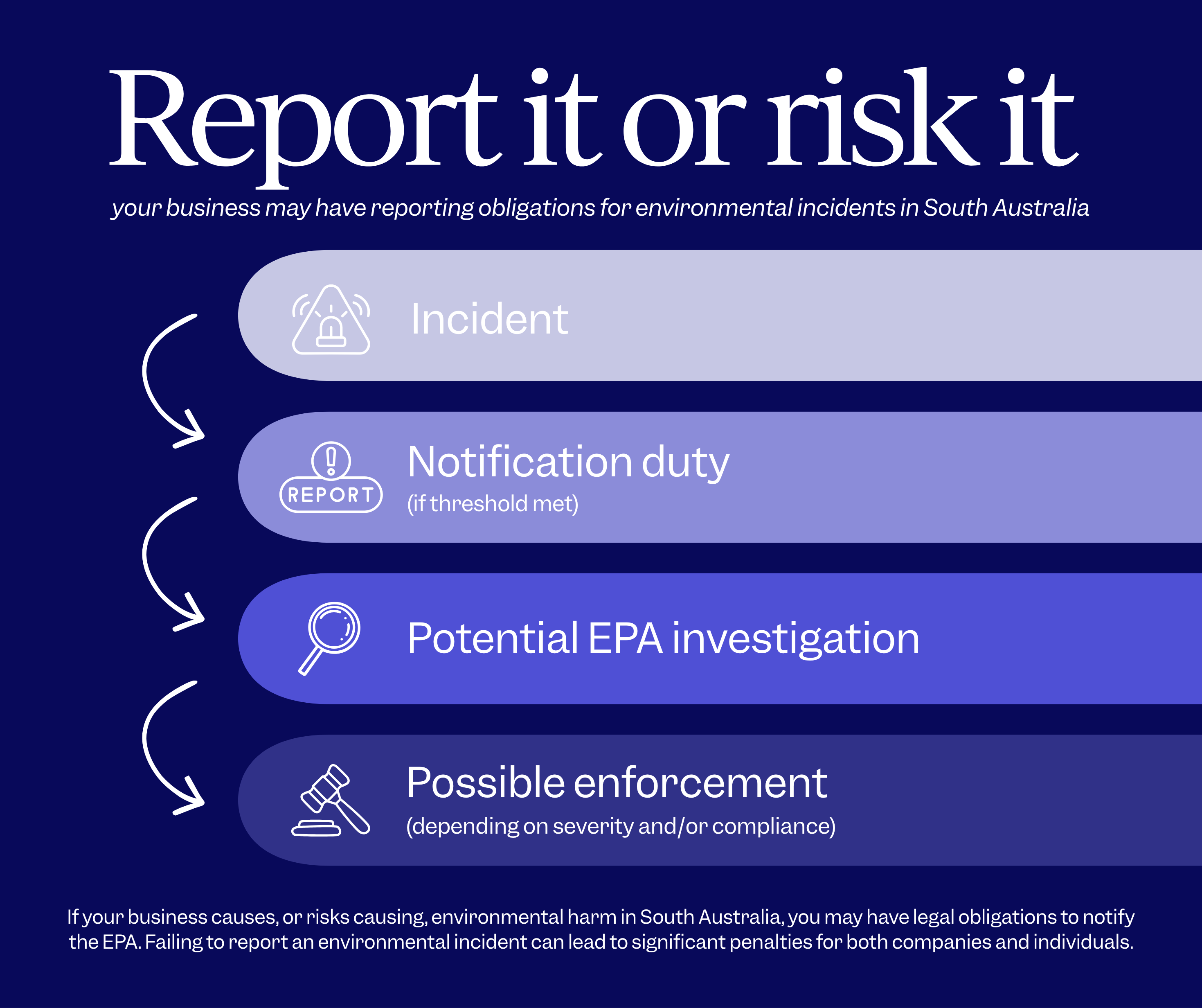
If your business causes, or risks causing, environmental harm, you may have legal obligations to notify the South Australian Environment Protection Authority (EPA). Failing to report an environmental incident can lead to significant penalties for both companies and individuals. This article outlines when notification may be required, how environmental harm is classified, and what businesses should expect if the EPA becomes involved.
When must businesses notify the EPA in South Australia
Businesses and employees undertaking prescribed activities in SA must remain mindful of the general environmental duty to not undertake an activity that pollutes, or might pollute, the environment unless all reasonable and practicable measures to prevent or minimise any resulting environmental harm have been taken. A breach of this general duty is not in itself an offence, but it can lead to related enforcement measures.
Beyond the general environmental duty, businesses and employees undertaking prescribed activities must also be mindful of the enforceable EPA notification obligations under South Australian environmental law, including the duty to notify the EPA where the individual or business has breached the Environment Protection Act 1993 (SA) (EP Act) by causing environmental harm, or where an impending breach is suspected or anticipated.
Environmental harm is classified under a three-tier system:
- Environmental nuisance is the lowest tier and covers pollution that unreasonably interferes with the amenity or enjoyment of an area or creates an unsightly or offensive condition;
- Material environmental harm covers high-impact or wide-scale nuisance, non-trivial actual or potential harm to human health or safety, or actual or potential loss or property damage exceeding $5,000;
- Serious environmental harm relates to high-impact or wide-scale harm to human health, safety or the environment, or actual or potential loss or property damage exceeding $50,000.
Importantly, the duty to notify of environmental incidents is not confined to individuals or companies holding a licence for a prescribed activity. There are several overlapping provisions that may impose obligations on individuals, including employees, to report certain types of environmental harm.
Reporting serious or material environmental harm to the EPA
Where serious or material environmental harm from pollution is caused or threatened in the course of an activity being undertaken, there is an obligation to notify the EPA of the harm or threatened harm as soon as reasonably practicable. This obligation applies to any person undertaking the activity in question, and therefore the responsibility rests upon not only the business but also its employees.
The EP Act also imposes a specific duty to notify the EPA as soon as practicable of site contamination affecting underground water. This duty relevantly applies to owners and occupiers.
A person is required to notify the EPA even if doing so might be self-incriminating; however, such notification cannot be relied upon in proceedings for an offence or the imposition of a penalty.
Director and officer liability under the EP Act
Importantly, where a body corporate commits an offence under the EP Act (including a failure to notify), an officer of the body corporate may also be guilty of an offence unless they can establish the offence did not result from a failure to take all reasonable and practicable prevention measures. An officer for the purpose of the EP Act includes an employee with management responsibilities in respect of the matters to which the contravention or alleged contravention relates. An officer can be guilty of an offence for knowingly promoting or acquiescing in the body corporate's contravention, and officers may even be prosecuted where the body corporate is not.
The penalties for failing to comply with EPA notification obligations are significant: depending on the specific offence, up to $250,000 for a body corporate and $150,000 for an individual.
EPA enforcement action in South Australia
The following prosecutions in the Environment, Resources and Development Court (ERD Court) illustrate the range of incidents and enforcement outcomes businesses may face.
During maintenance works at the Warren Reservoir in May 2023, SA Water released highly turbid water into the South Para River, impacting an area of at least 1.7 kilometres.
In September 2025, SA Water pleaded guilty to causing serious environmental harm and was ordered by the ERD Court to pay a $60,000 fine, EPA costs of $1,100, court costs and a Victim of Crime Levy. The Court heard that SA Water had already contributed $661,000 to the remediation of the South Para River, and the total estimated cost is expected to be $953,000.
In October 2017, Aurora Investments and Alex Panas (director of Aurora Investments) were responsible for the high-pressure cleaning of the asbestos roof at the Goodlife Gym located in Payneham, Adelaide. Both were charged with causing material environmental harm and failure to notify the EPA of environmental harm.
In the ERD Court, Aurora Investments and Alex Panas were convicted and fined. Aurora Investment was ordered to pay $24,000, along with $25,525.50 for the EPA’s clean-up costs. Alex Panas was fined $12,000 along with $1,030 in prosecution costs.
BWR operated a waste recovery and waste reprocessing facility without the required licence in early 2022. In May 2025, BWR was convicted and fined $20,000, discounted to $14,000 in recognition of an early guilty plea.
These cases underscore that EPA enforcement action in South Australia can arise not only from serious environmental harm but also from failures in licensing and notification compliance and licensing.
Practical steps for responding to an EPA investigation
Once an environmental incident has occurred, businesses should expect EPA investigation, regulatory engagement and potentially enforcement action. The EPA has broad powers to investigate and enforce compliance; for example, the EPA may issue clean-up orders requiring businesses to take specified remedial action within a specified period, including preparing and complying with plans of action, taking steps to prevent or mitigate further harm, and preparing ongoing compliance and monitoring reports.
In addition to clean-up orders, the EPA has a range of further enforcement measures available under the EP Act such as:
- environment protection orders to secure compliance with the general environmental duty;
- information discovery orders to obtain information reasonably required to administer or enforce the EP Act;
- suspension or cancellation of environmental authorisations, including where the holder has contravened the EP Act in connection with the authorised activity;
- civil penalties by negotiation or application to the ERD Court where the EPA is satisfied a person has committed an offence under the EP Act;
- civil remedies and court orders by application to the ERD Court, including orders restraining contraventions, requiring remedial action or payment of public authority costs, awarding compensation to affected persons, and ordering exemplary damages; and
- continuing penalties where an offence involves a continuing act or omission, for each day during which the act or omission continues.
How businesses can reduce environmental compliance risk
Businesses operating in South Australia, and particularly those undertaking prescribed activities, should ensure they are prepared in advance for the risk of an environmental incident.
For example, it is prudent to develop a comprehensive environmental incident response plan and have it reviewed by a lawyer to ensure it accurately reflects current statutory requirements. That plan may include:
- notifying the EPA or relevant authority of the incident as soon as practicable;
- engaging legal advisers immediately – early involvement of lawyers may help to ensure that subsequent correspondence and advice concerning the incident is subject to legal professional privilege;
- conducting internal investigations to understand the cause and extent of the incident, and maintaining readily available records;
- engaging independent experts through lawyers to assess the extent of the harm and advise on remediation;
- collating all relevant information to demonstrate that the incident did not result from any failure to take all reasonable and practicable measures, which may include, for example, relevant policies;
- identifying the appropriate staff to attend to the EPA’s investigation; and
- cooperating with the EPA throughout their investigation, which may be relevant to reducing any enforcement measures taken.
In addition to a post-incident response plan, your company may wish to also take the following precautionary measures:
- identifying, documenting and implementing reasonable and practicable measures your business will take to prevent or minimise environmental harm;
- ensuring all licences and environmental authorisations are current and compliant with any conditions, and implementing procedures to appropriately supervise employees undertaking prescribed activities;
- obtaining appropriate insurance and liabilities, for both the company and its directors;
- providing regular training to staff responsible for environmental compliance, including conducting periodic simulation exercises, and routine reviews of the plan to ensure efficacy.
A well-maintained environmental management policy, up-to-date licences, trained personnel and a clear post-incident action plan will place your business in the strongest possible position. Effective environmental compliance systems not only help minimise environmental harm but may also assist businesses responding to EPA investigations, enforcement action and environmental reporting obligations in South Australia.
Frequently asked questions - EPA notification obligations in South Australia
Businesses may be required to notify the EPA where serious or material environmental harm in the course of undertaking an activity has occurred or is threatened under the EP Act.
Environmental harm can include environmental nuisance, material environmental harm or serious environmental harm depending on the scale, impact and potential damage caused.
Yes. Officers, including employees with management responsibilities, may be personally liable for offences under the EP Act in certain circumstances.
Penalties can include fines of up to $250,000 for corporations and $150,000 for individuals depending on the offence.
Businesses should obtain legal advice early, preserve records, investigate the incident, cooperate with the EPA and implement remediation measures where required.
This article provides general comments only. It does not purport to be legal advice. Before acting on the basis of any material contained in this article, we recommend that you seek professional advice.
Author: Mila Elvish
Position: Law Clerk
Practice: Disputes
Related Insights
Driving the Green Revolution: Innovations in Hydrogen, Environmental Regulations, and Sustainable Energy Partnerships

Nicole Mead features on Smart Company – Watchdogs are cracking down on greenwashing, so how can your business back up its sustainability claims?

Contractual review for effective and ethical supply chains