Trump, Conflict and Oil: Contract Risk and Cost Allocation for SA Businesses
While much of the public discussion surrounding the US–Iran conflict has focused on geopolitical risk and macroeconomic stability, including escalating rhetoric from US President Donald Trump, the commercial effects are already being felt closer to home, through rising fuel costs, freight disruption and increasing pressure on margins. Despite the welcome double-sided ceasefire, shippers and airlines have cautioned there will be no immediate recovery and it will still take a period of months to get back to where supply needs to be given the disruption to the refining capacity in the Middle East
Chris Floreani specialises in M&A, banking and finance, and commercial transactions. His new three-part series takes a broader view, examining what these developments mean for South Australian businesses.
In this series, Chris explores the real-world implications of the crisis and how these disruptions are playing out within businesses themselves. Part 1 examines contractual risk, particularly who is legally and commercially responsible for rising costs. Part 2 will consider the likely impact on strategy and M&A activity, including where opportunities may emerge for well-positioned operators. Part 3 will address capital and funding, and how tightening credit conditions are influencing which businesses are able to act – and which are not.
Read on to find out more about how South Australian businesses could be affected by the disruption in the Middle East in Part 1.
On this page:
- The cost shock has arrived. Your contracts will decide who wears it.
- Key takeaways
- How geopolitical conflict is impacting SA businesses
- Where contract risk and cost exposure actually sits
- Do force majeure clauses apply to rising costs?
- Why fixed pricing contracts are driving margin pressure
- How supply chain disruption is affecting contract performance
- Termination rights and material adverse change (MAC) clauses
- Notice requirements in commercial contracts - why they matter
- What this looks like in South Australia
- What businesses should do now
- The takeaway
- How we can help
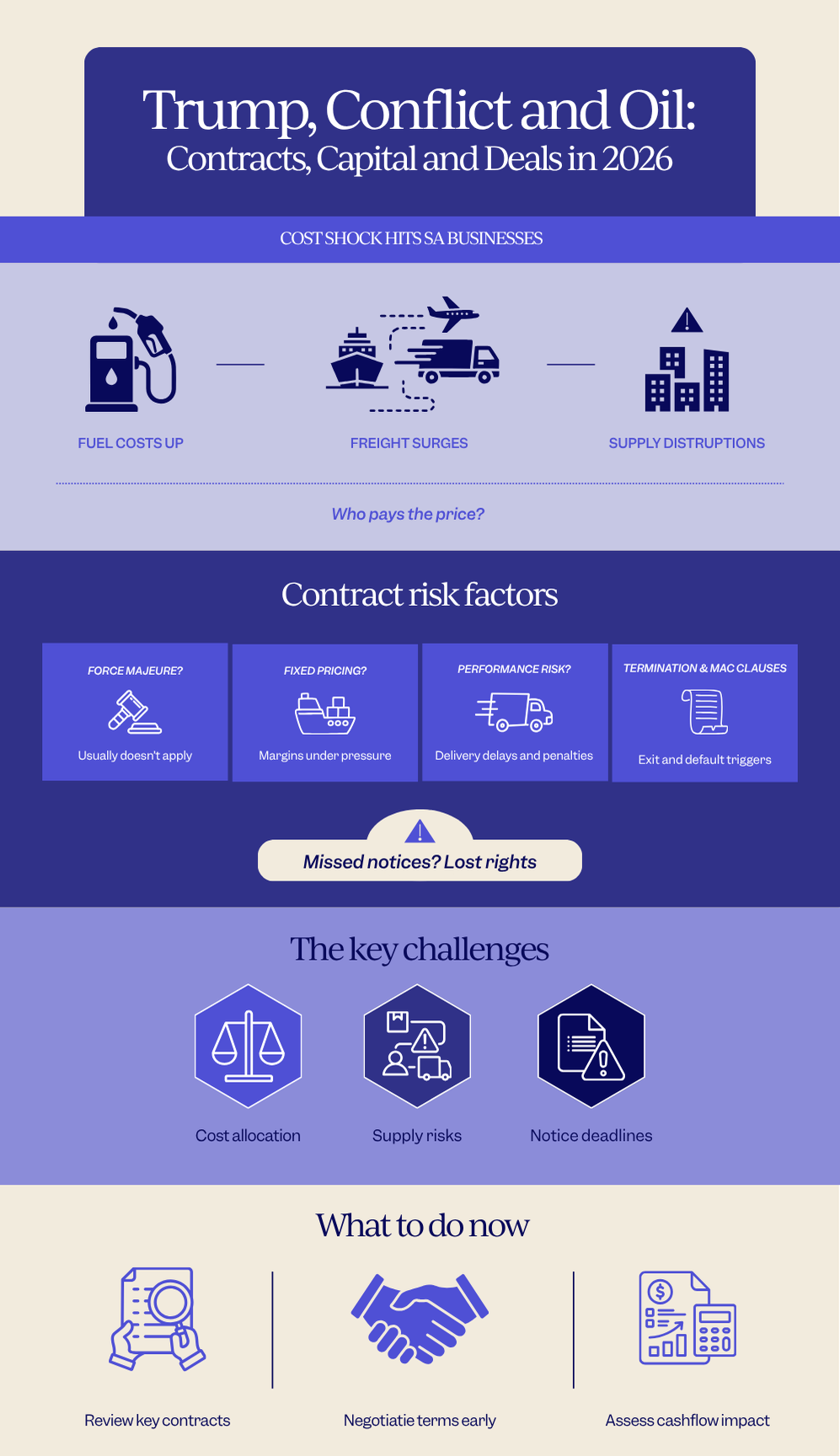
The cost shock has arrived. Your contracts will decide who wears it.
Over the past few weeks, the same themes have been emerging across South Australian businesses. Fuel is up. Freight is up. Suppliers are nervous. Margins are tightening. The natural question that follows is: "Can we pass rising costs on under our contracts?"
In most cases, the answer is not something you decide in real time. It is already set out in a contract that was signed months or years ago. This is fundamentally a question of contract risk, cost allocation and legal exposure in a rapidly changing economic environment.
Key takeaways
- Rising fuel and freight costs are being allocated through existing commercial contracts
- Force majeure clauses rarely apply to cost increases
- Fixed pricing contracts are creating significant margin pressure
- Supply chain disruption is increasing performance risk
- Missing notice requirements can extinguish contractual rights
- Reviewing contracts now is critical to managing legal and commercial risk
How geopolitical conflict is impacting SA businesses
The disruption caused by the US-Iran conflict and the effective closure of the Strait of Hormuz is not theoretical for South Australian businesses. It is already flowing through cost bases across transport, agribusiness, manufacturing and any business exposed to freight or energy inputs.
Most businesses do not import directly from the Middle East. But they are still importing the consequences - through fuel, freight and global pricing. While headlines focus on geopolitical escalation and oil price volatility, the commercial and contractual impact is already being felt locally. Right now, that impact is being allocated through contracts that were not written with this environment in mind.
Where contract risk and cost exposure actually sits
For most businesses, the immediate focus is operational - securing supply, managing customers and keeping things moving. But underneath that sits something more fundamental.
Commercial contracts determine:
- who absorbs rising costs;
- who can terminate or renegotiate; and
- who carries performance and delay risk.
In many cases, those contracts have not been revisited since they were signed. In a stable environment, that is usually fine. This is not a stable environment.
Do force majeure clauses apply to rising costs?
There has been a noticeable increase in businesses asking whether current conditions qualify as force majeure under their contracts. In most cases, they will not.
Force majeure clauses are typically drafted to deal with situations where contractual performance is prevented, not where performance has become more expensive or commercially unattractive. A spike in fuel costs, freight charges or general supply chain disruption will rarely be enough - unless performance is genuinely impossible.
That distinction is critical. Relying on a clause that does not apply does not solve the problem. It usually escalates it. The same applies to frustration. The threshold is even higher, and changes in commercial conditions (no matter how severe) will rarely be sufficient.
Why fixed pricing contracts are driving margin pressure
The more immediate issue across South Australian businesses is fixed pricing.
Many businesses committed to pricing in a very different cost environment. Those contracts are now sitting against a cost base that has shifted quickly and materially due to rising fuel costs, freight volatility and broader supply chain disruption. Transport operators are dealing with diesel-driven cost increases, agribusinesses are facing rising input and freight costs, and manufacturers are managing higher input costs and supply uncertainty.
In many cases, revenue is not moving with those costs. Where pricing is fixed and costs are variable, the gap must be absorbed somewhere - often by the party least able to sustain it.
How supply chain disruption is affecting contract performance
Cost is only part of the issue. Timing is becoming equally critical. Supply chain disruption upstream is now flowing through to performance downstream. Delays, missed deliveries and service interruptions are becoming increasingly common. However, many contracts still impose strict performance obligations.
Late delivery, service levels and liquidated damages do not automatically adjust because the operating environment has changed. As a result, businesses are not only absorbing higher costs - they are also increasingly exposed to contractual penalties linked to delays they did not cause.
Termination rights and material adverse change (MAC) clauses
At the same time, counterparties are reassessing their own positions. Customers facing rising prices may look for ways to exit or renegotiate. Suppliers under pressure may do the same.
This is where termination provisions and MAC clauses become critical. In many contracts, these rights are broader than expected. A loosely drafted default provision or broadly framed MAC clause can allow one party to step away from a deal or force a reset of commercial terms. These clauses are increasingly being tested - particularly in long-term supply arrangements and financing documents.
If you do not know whether a MAC clause exists in your key contracts, or how it operates, you may be missing a significant area of contract risk.
Notice requirements in commercial contracts - why they matter
One of the most common ways businesses lose contractual rights has nothing to do with legal substance - it is process.
Many agreements require formal notice to be given within strict timeframes to preserve rights. These timeframes are often short, and they are often missed. When that happens, the right itself can fall away - even if the underlying legal position would otherwise have been valid. This is one of the most overlooked areas of contract risk management.
What this looks like in South Australia
The impact will land unevenly across the South Australian economy, but the pressure points are clear.
- Transport and logistics businesses are dealing with immediate fuel cost increases;
- Agribusinesses are facing input cost pressure and freight volatility; and
- Manufacturers are experiencing both cost increases and supply uncertainty.
Many of these businesses operate on tight margins and within ownership structures where risk sits with founders or families - not large corporate balance sheets. That makes contractual allocation of risk even more important.
What businesses should do now
This does not require a full legal overhaul - but it does require focused attention.
Businesses should:
- review key commercial contracts, including supply and revenue agreements;
- map where pricing is fixed against rising input and operational costs;
- identify any contractual price adjustment mechanisms;
- assess termination rights and MAC clause exposure; and
- ensure notice requirements are being met in real time.
At the same time, there is a broader commercial question: What does this cost environment do to working capital if it persists for six to twelve months? That question is directly linked to what sits in your contracts.
The takeaway
This is not just a cost issue - it is a contract risk and cost allocation issue.
For most businesses, that allocation has already been agreed. It is embedded in commercial contracts drafted in a very different economic environment. Businesses that understand their contractual position early will have options - to renegotiate, adjust and manage exposure. Those that do not will find themselves reacting later, with fewer levers available.
This article provides general commentary only. It is not legal advice. Before acting on the basis of any material contained in this article, seek professional advice.
How we can help
At DMAW Lawyers, we work with South Australian businesses across commercial contracts, M&A, and banking and finance in exactly these scenarios.
We can provide:
- targeted reviews of key commercial contracts;
- identification of pricing exposure and termination risk; and
- practical, commercially focused legal advice.
We focus on identifying where the real pressure points sit, so you can make informed commercial decisions early.
Related Insights
Trump’s trade power play: What it means for South Australian businesses

Middle East geopolitical tensions: Key risk considerations for construction and major projects