

Early Contractor Involvement (ECI): A practical snapshot for contractors
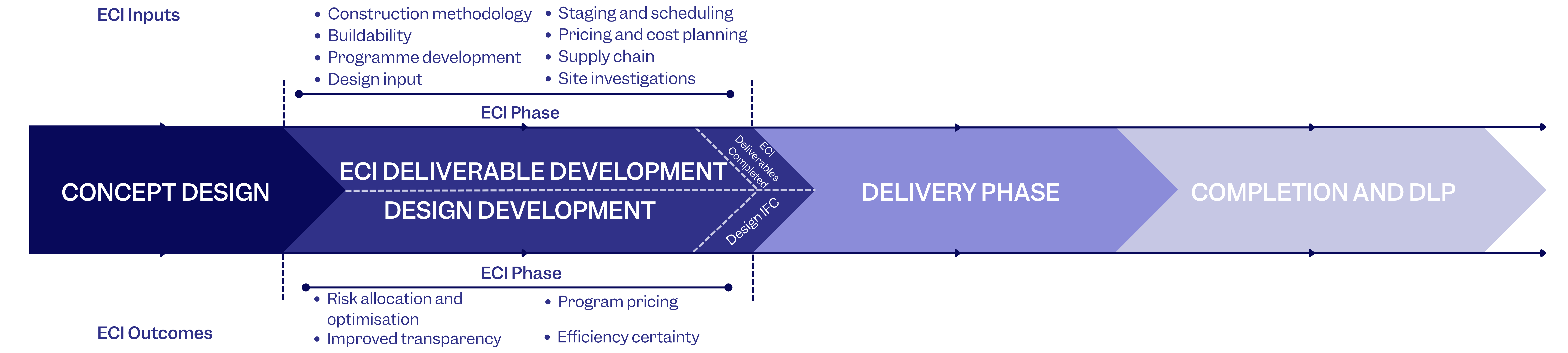
Early Contractor Involvement (ECI) involves the early engagement of contractors in a building or construction project, allowing an opportunity for principals, contractors and consultants to align on key project issues such as design, buildability, programming and construction methodology.
ECI is most frequently used on projects where a principal intends to engage a contractor on a construct-only basis but requires (or wants) input from the contractor before construction begins. By engaging a contractor during the final stages of design development, ECI can improve buildability, test methodology and sequencing, and bring greater clarity to cost planning and programming before the construction phase begins.
There can also be considerable benefits to ECI during a design and construct (D&C) engagement even though design and construction interface risk already rests with the contractor. In a D&C context, ECI can therefore be viewed more about risk optimisation rather risk allocation, with a focus on pricing certainty and programme efficiency.
Despite its benefits, ECI is not risk-free and can expose contractors to risk if responsibilities and assumptions are not carefully managed.
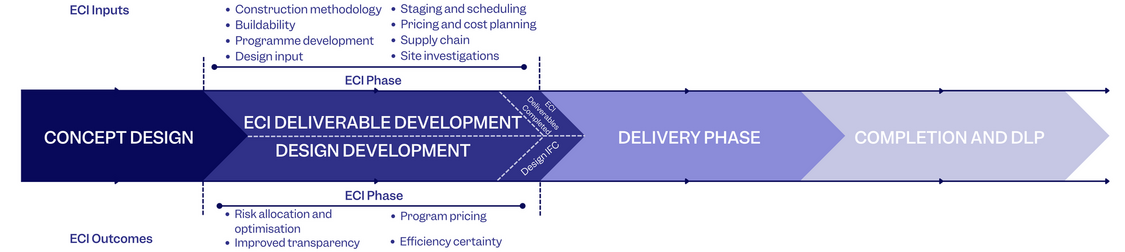
Timeline
No guaranteed works phase
While some ECI models provide contractors with exclusive negotiation rights to tender for the work, others allow the principal to run a fresh tender process, in either case proceeding to the works phase is not guaranteed. If the project does not proceed, or if the principal elects to engage another contractor for the construction phase, ECI costs may never be recovered unless the agreement specifically provides for it.
Therefore, contractors should always consider:
- what rights the contractor has in terms of proceeding to the construction phase;
- what services the contractor is being paid for during the ECI phase;
- whether payment is fixed, capped, or contingent (and the method of calculation); and
- what happens if the contractor’s engagement stops after the ECI phase.
Implementing safeguards against these considerations before entering into an agreement involving ECI works can ensure a contractor is not left out of pocket once the ECI phase finishes.
Design Advice vs Design Liability
The ECI phase often requires contractors to work closely with designers, which can create a risk that advisory input by the contractor may be treated as de facto design responsibility.
Contractors need to consider what design responsibility they are assuming during ECI and make sure the contract aligns, ensuring that, for contractors engaged on a construct-only basis, the agreement does not create back-door design obligations or liability.
IP risks in ECI deliverables
Mismanagement of intellectual property during the ECI phase can leave contractors out of pocket and erode their competitive advantage in the market. This is particularly so if contractors are developing or making available unique solutions, methodologies, and/or staging plans during their ECI engagement.
It is important that contractors clarify the terms around intellectual property rights when negotiating the agreement, including:
- who owns any intellectual property, both existing and developed during the ECI phase;
- whether the intellectual property rights are being licensed or transferred to the principal;
- whether the principal can use intellectual property developed by the contractor during ECI if another contractor is selected to complete the work; and
- what, if any, compensation will the contractor receive if it is handing over its intellectual property.
The bottom line
The ECI phase can be a powerful tool for contractors to not only show their skill and capability, but to reduce and manage risk and drive successful project outcomes. However, it is important that contractors have a good understanding of what they are signing up to and have appropriate contractual safeguards in place to ensure their commercial interests are protected.
DMAW Lawyers has significant experience in providing advice to contractors in relation to the ECI phase of projects and can provide tailored and practical advice to suit any situation.
Please get in touch with us if you’d like to discuss your next upcoming project.
This article provides general commentary only. It is not legal advice. Before acting on the basis of any material contained in this article, seek professional advice.
Author: Ben Millman
Position: Associate
Practice: Disputes
Author: Chloe Katzer
Position: Lawyer
Practice: Transactions
Our construction and projects expertise
In our construction law practice, we take a practical, hands-on approach, helping you manage risk, protect your commercial interests, and keep your project on track. Whether it’s negotiating contracts or resolving disputes, our construction lawyers stay close, responsive, and focused on achieving the best outcomes for your project.
Find out more about our construction and projects expertise.
Our construction and projects experts

Principal
Matthew is a principal in the firm’s transactions practice. He has expertise across a range of industries and in particular, mining and resources, construction materials, property development, airports, construction, agriculture and not-for-profit.

Principal
Patrick is a principal in the firm’s disputes team. Patrick is an experienced commercial dispute resolution lawyer with a broad ranging practice.

Principal
Tom is a principal within the firm’s disputes practice. Tom specialises in commercial disputes. He has acted in a full spectrum of complex commercial litigation, construction, superannuation, transport and trade matters.

Senior Associate
Ben is an associate in the firm’s disputes practice. He has experience working on a broad range of commercial disputes and provides front-end contract and risk advice, primarily to the firm’s commercial construction industry clients.
Related Insights
Snapshot: AS4000:2025 – Updates to one of Australia’s most commonly used forms of construction contract

Obligation to ensure proper supervision of building work

"Building on Insight" with DMAW Lawyers boardroom luncheon
How to avoid a construction catastrophe
